The Art of Masami Suda
Long before anime conquered the world, Masami Suda was already shaping its heroes. From the brutal landscapes of Hokuto no Ken to the fierce rivalries of Sakigake!! Otokojuku, his bold character designs helped define the raw energy of 1980s Japanese animation. This is the story of the artist behind the legends.

Masami Suda, 2007. Photo: Georges Seguin (Okki) / Wikimedia Commons, CC BY-SA 3.0
The Animator Who Gave Anime Its Weight
Before Kenshiro became one of the most recognizable silhouettes in Japanese animation, before Hokuto no Ken turned exploding muscles and monumental poses into an international visual language, Masami Suda had already spent nearly two decades learning how to make drawings move.
His career is extraordinary not simply because of its length, but because of what it connects.
Speed Racer. Gatchaman. Starzinger. Toward the Terra. Hokuto no Ken. Sakigake!! Otokojuku. Slam Dunk. Yu-Gi-Oh!. Street Fighter II. Psycho-Pass. Yo-kai Watch.
Few animators can claim a filmography that passes through so many different eras of Japanese animation.
Suda was not merely a designer of muscular heroes. He was one of the artists who understood something fundamental about animation: a powerful drawing is not necessarily a complicated drawing. It is a drawing that survives movement.
That idea runs through his entire career.

Before Animation, There Was Music
Masami Suda was born on September 16, 1943, in Saitama Prefecture.
One of the more surprising details of his biography is that animation was not his original plan. Suda had studied at the Japan Jazz School and described himself as a musician before entering the animation world. A friend told him there was work available for people who could draw. Suda had drawn since childhood, so he decided to try.
The beginning was hardly glamorous.
His professional biography records that he initially entered Tatsunoko Production but left after only four months because he was not being given the opportunity to draw. He then trained at A Production, later known as Shin-Ei Animation, spent time at Tama Production, where he worked on Mach GoGoGo — Speed Racer internationally — and became freelance.
Then came the encounter that changed everything.
Suda returned to Tatsunoko to audition for Kurenai Sanshiro — Judo Boy — a series whose more realistic human characters suited his abilities. Tatsunoko founder Tatsuo Yoshida noticed him. Suda would later describe Yoshida as his lifelong master.
From there, Suda became part of the extraordinary generation of artists who built Tatsunoko’s visual identity during the late 1960s and 1970s.
Drawing at Television Speed
To understand Suda, it is important to understand the conditions in which his drawing developed.
Japanese television animation was being produced at remarkable speed. Suda worked on Oraa Guzura Dado, Dokachin, Kurenai Sanshiro, Hakushon Daimao, Animentary: Ketsudan and The Adventures of Hutch the Honeybee, moving between key animation and in-between animation.
Production records cited by Japanese sakuga historians preserve an astonishing detail from this period: during Hakushon Daimao, Suda reportedly handled both key and in-between animation on as many as three episodes per month. The rhythm was described as roughly one week of drawing, several days physically exhausted, then back to work.
Suda himself later recalled working through repeated sleepless nights at Tatsunoko until he became seriously ill. At the hospital, a doctor joked that if he continued at that pace, he was essentially already dead — an anecdote Suda found particularly funny years later after becoming associated with Hokuto no Ken.
The experience profoundly affected his attitude toward work. He remained freelance for most of his career and valued the ability to move between productions rather than being permanently attached to one studio.
Gatchaman: Learning to Draw Movement
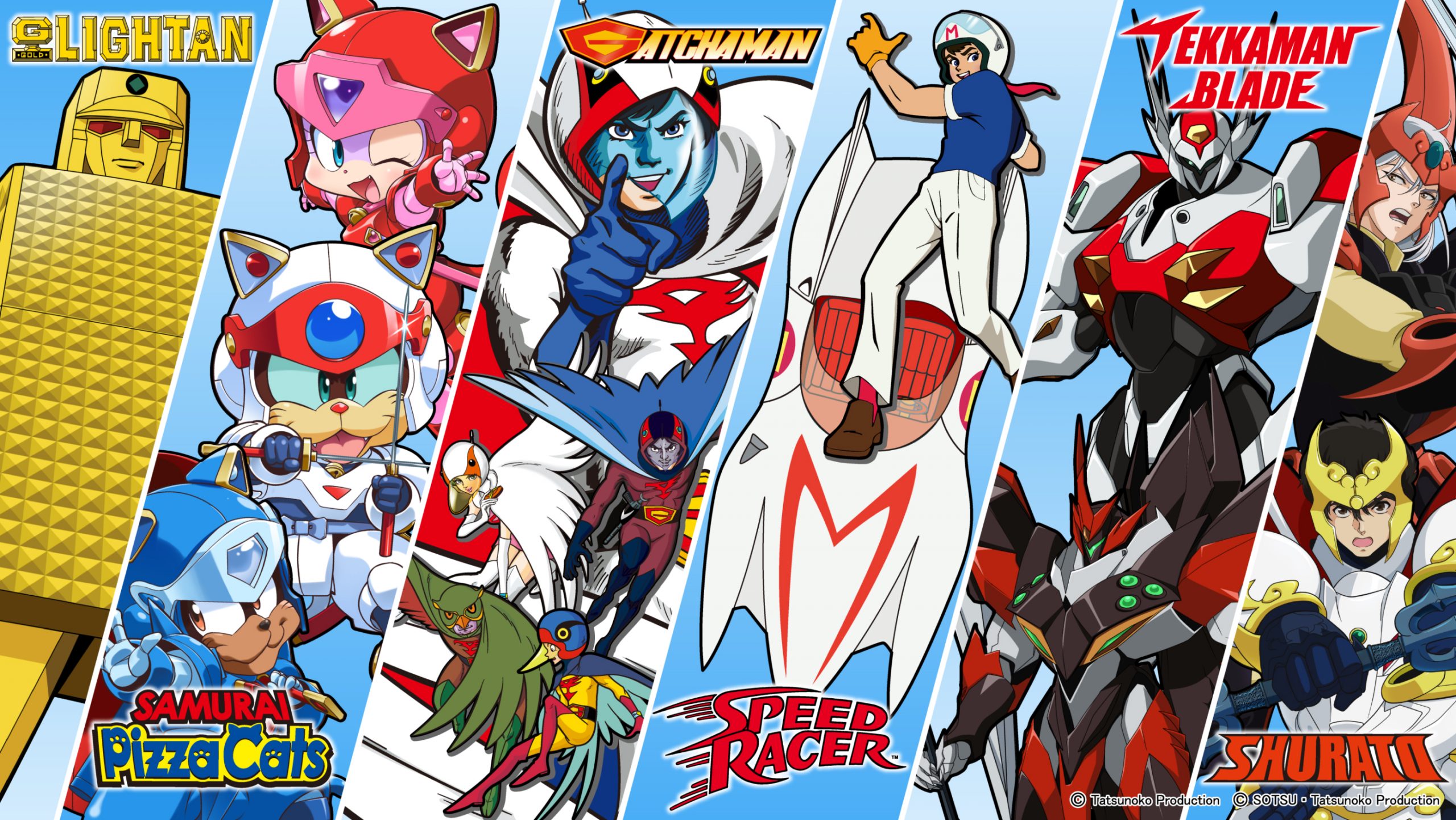
In 1972, Tatsunoko launched Science Ninja Team Gatchaman.
Suda did not create the original character designs — those belong to Tatsuo Yoshida — but he became an important animator on the series. Staff records reconstructed from the original episode credits list Suda on numerous episodes, including the first, working on key and in-between animation.
For Suda, Gatchaman became a crucial artistic education.
The characters jumped, spun, flew through the air and fought acrobatically. He later contrasted it directly with Hokuto no Ken: Gatchaman communicated energy through movement, whereas Hokuto no Ken would learn to communicate power even when almost nothing moved.
That distinction is one of the keys to understanding his work.
Movement in Suda’s animation is never simply about speed. It is about weight, posture and intention.
His association with the franchise continued. He worked on the opening animation of Gatchaman II and later as animation director on Gatchaman F.
Around the same period his credits include Hurricane Polymar, Tekkaman: The Space Knight, Time Bokan, Machine Hayabusa, Candy Candy, Magne Robo Ga-Keen and Barattack.
It is a remarkable cross-section of 1970s television anime.

Starzinger: Becoming a Character Designer
A major turning point came in 1978.
Toei Animation entrusted Suda with the character design of SF Saiyuki Starzinger, its science-fiction reinterpretation of Journey to the West associated with Leiji Matsumoto. It was Suda’s first major television assignment as a character designer. Toei’s own production archive credits him as the series’ character designer.
This matters because Starzinger already reveals what would become a central part of Suda’s career: translating an existing graphic universe into forms that animators can actually use.
Character design in animation is not illustration.
A beautiful drawing that cannot maintain its proportions from frame to frame is a bad production design. A character needs to work from multiple angles, under different expressions, in action, and in the hands of dozens of different artists.
Suda understood this exceptionally well.
By the beginning of the 1980s, his responsibilities had expanded considerably. On the 1980 theatrical adaptation of Keiko Takemiya’s Toward the Terra, Toei credits him as animation director and as part of the mechanical design project team. His professional filmography also includes major design and animation supervision work on Future War 198X.
He was no longer simply executing movement.
He was increasingly defining how entire productions should look.

Hokuto no Ken: The Problem of Too Many Lines
Then, in 1984, came the work that would define his name.
Toei Animation selected Suda as character designer for the television adaptation of Buronson and Tetsuo Hara’s Hokuto no Ken. Toei’s official credits list him as character designer for the television production that ran from 1984 through Hokuto no Ken 2.
The assignment presented a fundamental problem.
Tetsuo Hara’s manga drawings were dense, anatomical, heavily shaded and filled with lines. They were extraordinarily effective as still images but extremely difficult to reproduce consistently across thousands of animation drawings.
Suda’s solution was more sophisticated than simply “simplifying” Hara.
He removed information where movement required clarity, but then deliberately reintroduced density in controlled places through stronger lines, deeper facial construction and layered shadow shapes.
As Suda explained years later, animation required reducing the manga’s enormous quantity of lines so characters would not deform while moving. Yet he did not want the usual smooth television-anime appearance. He deliberately added selected lines and multiple levels of shadow to restore visual depth.
That apparent contradiction — remove lines, then strategically add lines back — is one of the secrets of the Hokuto no Ken aesthetic.

How Do You Animate a Body That Looks Like a Statue?
Kenshiro’s body is not designed like a normal animated body.
Neither is Raoh’s.
Hara’s characters resemble heroic sculpture: vast shoulders, tiny waists, enormous trapezius muscles, heavy necks, impossible torsos.
The temptation would have been to animate them constantly in order to demonstrate their strength.
Suda understood the opposite.
He later described Hokuto no Ken as much more static than Gatchaman. In Gatchaman, energy came from flight and acrobatics. In Hokuto, power could exist without movement.
A lowered head.
A shoulder occupying half the frame.
A figure standing completely still while clothing moves in the wind.
A face divided by a hard shadow.
A body that seems to have mass before it throws a single punch.
These are not simply stylistic choices. They are production solutions.
Suda found a visual grammar in which limited television animation could actually make the characters feel more monumental, not less.
This is why so many frames from the series remain striking when isolated today.
They were designed to hold the screen.

Kenshiro Was Not Easy
Suda continued refining the designs as Hara’s own manga artwork evolved.
The early Kenshiro of the manga was younger and graphically less complex; as Hara’s drawing became increasingly realistic and detailed, the television design also had to evolve. Suda acknowledged that keeping up with that development was difficult not only for him but for the animation directors responsible for maintaining the character on model.
The 1986 theatrical Hokuto no Ken gave the production more room to push the visual density further. Suda served as animation director on the film, while his professional filmography also credits him with its character design.
And his influence did not end with model sheets.
Junichi Hayama, who would himself become one of the animators most closely associated with Hokuto no Ken, later remembered Suda demonstrating corrections with extremely quick sketches. A few lines made in seconds could show exactly where the weight or emphasis of a drawing needed to change. Hayama described watching Suda translate Hara’s density into animation as an important learning experience.
That is perhaps the best description of Suda’s real talent.
Not detail for the sake of detail.
Knowing exactly which detail matters.
Otokojuku: Pushing the Masculine Silhouette Even Further
In 1988 Suda became character designer of Toei’s adaptation of Akira Miyashita’s Sakigake!! Otokojuku.
At first glance it belongs to the same visual territory as Hokuto no Ken: gigantic men, extreme physiques, violence, dramatic faces.
But the tone is different.
Hokuto uses monumentality to create tragedy and myth.
Otokojuku frequently uses monumentality until it becomes almost absurd.
The bodies remain powerful, but the silhouettes are more theatrical. Expressions can move from dead seriousness to grotesque comedy. Suda had to preserve Miyashita’s exaggerated world without allowing it to collapse into visual noise.
[IMAGE: Otokojuku Production Art 01]
There is also an extraordinary technical detail hidden in the production history.
Credit-based Japanese sakuga records list Suda as animation director on episodes 1, 7, 13 and 29 and indicate that on episodes 13 and 29 he also handled the key animation alone. The same records identify several Hokuto no Ken 2 episodes in which he performed solo key animation while also serving as animation director.
For someone known primarily today as a “character designer,” this is an important reminder.
Masami Suda could still sit down and animate.


The Filmography Is Much Stranger Than You Think
Reducing Suda’s career to Hokuto no Ken misses how unusually versatile he was.
During the 1980s he contributed key animation to Dr. Slump, the first Dragon Ball theatrical film, City Hunter, Minky Momo and other productions while simultaneously handling much heavier design and animation-direction work.
In 1989 he was animation director on episode 37 of Tenku Senki Shurato. In 1990 he supervised the opening animation of Samurai Pizza Cats. He later worked on Tekkaman Blade, designed the 1993 Rokudenashi Blues film, and became one of the animation directors on Slam Dunk.
Then the list becomes even more eclectic.
He contributed key animation to the 1994 Street Fighter II Movie. He worked as animation director on Cutie Honey F and the original 1998 Toei television adaptation of Yu-Gi-Oh!. He returned to Mach GoGoGo for its 1997 remake as character designer and animation director — three decades after having worked on the original.
In the 2000s he continued working across genres on productions including Salaryman Kintaro, F-Zero: GP Legend, Transformers: Energon, Viewtiful Joe, Angel Heart, Hellsing Ultimate and Hayate the Combat Butler.
And even in the following decade, his credits included Giant Killing, the Pokémon: Zoroark — Master of Illusions movie, Inazuma Eleven, and key animation on the first episode of Psycho-Pass.
That trajectory is remarkable.
An animator who began on Speed Racer in the 1960s was still providing drawings for Psycho-Pass forty-five years later.


From Kenshiro to Jibanyan
Perhaps the most unexpected chapter arrived when Suda was around seventy years old.
In 2014 he became character designer for the television anime Yo-kai Watch. TV Tokyo’s official credits list Takuzo Nagano and Miho Tanaka for the original yokai and character concepts, with Masami Suda responsible for adapting them as animation character designs.
It could hardly look more different from Hokuto no Ken.
And yet the underlying problem was exactly the same.
Suda explained that simply copying game artwork would not necessarily result in good animation. Characters sometimes needed their proportions deliberately stretched or distorted so their movements would read better on screen.
Kenshiro and Yo-kai Watch therefore sit at opposite ends of the same philosophy.
One requires removing lines from an incredibly dense manga drawing.
The other requires modifying an apparently simple game design.
In both cases, the question is:
How does this character need to be drawn in order to move?
That is Masami Suda’s real subject.

One Career, Several Completely Different Languages
Late in his life, Suda described his career not as a straight evolution but as a series of major artistic gaps connected by one continuous thread.
He singled out Gatchaman for its youthful, almost dancing movement; Hokuto no Ken for its heavier and more static graphic power; and Yo-kai Watch for the pleasure of play and deformation.
It is an unusually accurate summary of his work.
Suda did not spend fifty years perfecting one recognizable style.
He spent fifty years solving different animation problems.
That distinction is important.

Why Individual Drawings Mattered to Him
Suda was also unusually outspoken about what he believed modern animation risked losing.
He did not simply reject digital production. His criticism was more specific.
As animation became more detailed and production pipelines grew, he observed that an episode that might once have involved around ten artists could involve twenty or thirty. More people meant more corrections, more supervision and greater pressure to homogenize the final image.
What concerned him was the gradual disappearance of the animator’s identifiable hand.
Earlier animators, he argued, often possessed styles that viewers and other professionals could recognize immediately. Modern production demanded greater consistency, which could make such individual signatures harder to preserve.
It was not nostalgia for cels simply because they were cels.
For Suda, animation had begun as a handmade medium, and that human presence remained essential even as the technology evolved.

A Note for Collectors: What “Masami Suda Production Art” Actually Means
There is an important distinction when looking at original artwork from productions associated with Suda.
Suda’s credit as character designer means he established the visual system from which the animation staff worked. It does not mean that every surviving cel, douga or genga from Hokuto no Ken or Otokojuku was personally drawn by him.
A production cel was part of a collective pipeline. The underlying animation drawing might have been produced by an episode’s key animator, corrected by an animation director, transferred to a cel and painted by the finishing department.
Direct attribution to Suda therefore requires more specific evidence: a known key-animation sequence, a correction drawing, model sheet, layout, signed work or documented production provenance.
That distinction does not diminish the importance of the production art.
Quite the opposite.
A cel or drawing from a Suda-designed production is evidence of how his visual language was translated through an entire animation studio.
For collectors, that production process is part of the object’s history.

The Name Hidden in the Credits
There is even a small detail that collectors of Japanese production material may encounter.
Suda’s name is normally written 須田正己, but a variant, 須田正巳, appears in a number of production credits. Toei’s surviving official pages for Starzinger, Hokuto no Ken and Sakigake!! Otokojuku, for example, use the second spelling. Japanese animation reference sources also note that he was frequently credited this way.
It is the same Masami Suda.
A tiny piece of animation history hidden in the kanji.

Recognition and Legacy
In 2018, the Tokyo Anime Award Festival honored Masami Suda with its Achievement Award, recognizing his contribution to Japanese animation. The festival followed this by commissioning him to create the main visual for TAAF 2019.
Suda died at his home on August 1, 2021, aged 77.
His career had lasted more than half a century.
But its importance cannot really be measured by duration.
Masami Suda belonged to a generation for whom character design, key animation and animation direction were not isolated disciplines. A designer had to understand movement. An animation director had to understand anatomy. An animator had to understand what could be removed from a drawing without destroying its personality.
That knowledge is visible everywhere in his work.
In the airborne bodies of Gatchaman.
In the strange cosmic heroes of Starzinger.
In Kenshiro standing almost motionless beneath a black sky.
In the impossible mass of Raoh.
In the grotesque warriors of Otokojuku.
In a basketball player from Slam Dunk.
And, improbably, decades later, in the elastic proportions of a child from Yo-kai Watch.
Masami Suda did not simply design characters.
He understood what a drawing had to become before it could live.